Examples
Examples of using Tuner widgets and bindings.
Simple entry
Let's add Tuner.Entry inside empty group:
blp
using Gtk 4.0;
using Tuner 1;

translation-domain "tuner-base";

Tuner.Page {
    title: _("New Page");
    icon-name: "computer-symbolic";

    Tuner.Group {

        Tuner.Entry {
            title: _("Our cool entry");
            show-apply-button: true;
        }
    }
}
But that entry will not be displayed without binding, so add FileContent binding:
blp
Tuner.Entry {
    title: _("Our cool entry");
    show-apply-button: true;

    binding: Tuner.FileContent {
        path: "~/1.txt";
    }
}
Result

sh
$ cat 1.txt
test
That entry now will by synced with 1.txt file inside current user home folder.
Property show-apply-button allows to save entered text only after pressing Enter or special apply button.
Better file content binding
Now let's create binding with custom behaviour.
vala
public class Base.SimpleJson : Tuner.Binding {
    public string path { get; set; }
    public string name { get; set; }
    public override Type expected_type { get { return Type.STRING; } }

    // Load json content to our entry
    public override bool get_value(ref Value value) {
        try {
            var parser = new Json.Parser();
            if (parser.load_from_file(Tuner.FileUtil.expand_home(path))) {
                var root = parser.get_root();
                if (root != null && root.get_object() != null && root.get_object().has_member(name)) {
                    var node = root.get_object().get_member(name);
                    if (node != null && node.get_string() != null) {
                        value.set_string(node.get_string());
                        return true;
                    }
                }
            }
        } catch (Error e) {
            warning("Error: %s\n", e.message);
        }

        return false;
    }

    // Write contents of our entry to file
    public override void set_value(Value value) {
        try {
            Json.Node target = null;

            var parser = new Json.Parser();
            if (parser.load_from_file(Tuner.FileUtil.expand_home(path))) {
                var root = parser.get_root();
                if (root != null && root.get_object() != null) {
                    root.get_object().set_string_member(name, value.get_string());
                    target = root;
                }
            }

            if (target == null) {
                target = new Json.Builder()
                    .begin_object()
                    .set_member_name(name)
                    .add_string_value(value.get_string())
                    .end_object()
                    .get_root();
            }

            var generator = new Json.Generator();
            generator.set_root(target);
            generator.to_file(Tuner.FileUtil.expand_home(path));
        } catch (Error e) {
            warning("Error creating/writing file: %s", e.message);
        }
    }
}
Don't forget to register the type if it will be used in markup!
vala
// Insert before calling add_from_resource
typeof(Base.SimpleJson).ensure();
Not let's use our binding in markup:
blp
using Gtk 4.0;
using Tuner 1;

translation-domain "tuner-base";

Tuner.Page {
    title: _("New Page");
    icon-name: "computer-symbolic";

    Tuner.Group {

        Tuner.Entry {
            title: "Name";
            show-apply-button: true;

            binding: $BaseSimpleJson {
                path: "~/1.json";
                name: "name";
            };
        }

        Tuner.Entry {
            title: "Surname";
            show-apply-button: true;

            binding: $BaseSimpleJson {
                path: "~/1.json";
                name: "surname";
            };
        }
    }
}
With that binding entry text will be written to file with specified path only to json member with specified name withot overriding other members.
Result
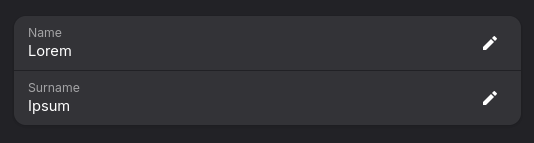
sh
$ cat 1.json
{"name":"Lorem","surname":"Ipsum"}